
Submit a Manuscript to the Journal
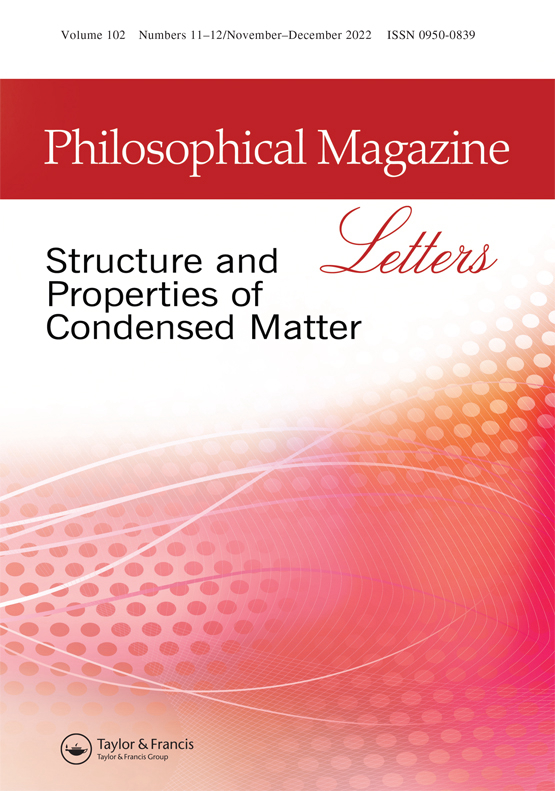
Philosophical Magazine Letters
For an Article Collection on
Nanomaterials for Energy Applications: Bridging Computational and Experimental Frontiers
Manuscript deadline

Article Collection Guest Advisor(s)
Dr. Bradha Madhavan,
Rathinam Research Hub, Rathinam Technical Campus, Coimbatore, India
bradhaaraj@gmail.com
Dr. Mario Di Nardo,
Department of Chemical, Materials, and Industrial Production Engineering, University of Naples Federico II, Italy
mario.dinardo@unina.it
Dr. Yuvaraj Subramanian,
University of Ulsan, South Korea
yuvarajs22@yahoo.com
Benefits of Publishing in an Article Collection
An Article Collection is an opportunity for your research to reach the right audience. Bringing together the work of the global research community, Collections provide readers with a central place to find the latest research on emerging and important topics. They have been found to increase the discoverability and visibility of each article, as well as article-level citations.
Nanomaterials for Energy Applications: Bridging Computational and Experimental Frontiers
The transition toward sustainable and low-carbon energy systems has created an urgent demand for advanced functional materials capable of improving the efficiency, durability, and affordability of energy technologies. Nanomaterials have emerged as key candidates owing to their unique structural, electronic, optical, and catalytic properties that differ significantly from those of bulk materials. Recent advances in computational materials science, combined with sophisticated experimental synthesis and characterization techniques, have accelerated the discovery and optimization of nanomaterials for applications in photovoltaics, batteries, supercapacitors, fuel cells, hydrogen production, thermoelectric devices, and energy harvesting systems. This Article Collection seeks to highlight cutting-edge research that integrates theoretical modeling, computational simulations, data-driven approaches, and experimental validation to advance the development of nanomaterials for next-generation energy applications.
Addressing global energy and environmental challenges requires innovative materials solutions that can enhance renewable energy conversion, energy storage, and clean fuel production. Traditional trial-and-error materials development is often time-consuming and resource intensive. Computational approaches such as density functional theory, molecular dynamics simulations, machine learning models, and multiscale frameworks provide powerful tools for predicting material properties and guiding experimental efforts. When combined with advanced characterization techniques, these approaches enable a deeper understanding of structure-property relationships and significantly accelerate materials discovery. The integration of computational and experimental methodologies is therefore transforming the way energy materials are designed, optimized, and deployed. This Collection aims to showcase recent breakthroughs that demonstrate how such interdisciplinary strategies are contributing to sustainable energy technologies and expanding the frontiers of materials research.
This Article Collection welcomes original research articles, short communications, and review papers covering computational, theoretical, experimental, and applied aspects of nanomaterials for energy applications. Topics of interest include computational design of nanomaterials for solar energy conversion; advanced electrode materials for batteries and supercapacitors; nanostructured catalysts for hydrogen evolution and oxygen evolution reactions; fuel-cell materials and electrocatalysts; thermoelectric and piezoelectric nanomaterials; two-dimensional materials and heterostructures; machine learning and artificial intelligence for materials discovery; multiscale modeling approaches; high-throughput computational screening; and experimental validation using advanced characterization techniques such as electron microscopy, spectroscopy, and synchrotron-based methods. Contributions that bridge computational predictions with experimental realization are particularly encouraged.
Keywords: Nanomaterials; Energy Materials; Computational Materials Science; Fuel Cells and Hydrogen Energy; Machine Learning for Materials Discovery
All manuscripts submitted to this Article Collection will undergo desk assessment and peer-review as part of our standard editorial process. Guest Advisors will not be involved in peer-reviewing manuscripts unless they are an existing member of the Editorial Board.
Please review the journal scope and author submission instructions prior to submitting a manuscript.
The deadline for submitting manuscripts is 31 March 2027.
Please contact Agnes Zhou at Agnes.Zhou@taylorandfrancis.com with any queries regarding this Article Collection.
For Taylor and Francis Journals: Please be sure to select "Nanomaterials for Energy Applications: Bridging Computational and Experimental Frontiers" from the drop-down menu in the submission system.
Dr. Bradha Madhavan is a materials scientist specializing in computational and experimental investigations of advanced functional materials for sustainable energy applications. His research focuses on solid oxide fuel cells, perovskite oxides, hydrogen production, electrocatalysis, and energy storage materials. He has published extensively in international peer-reviewed journals and actively collaborates with researchers across academia and industry. His work integrates materials synthesis, characterization, and computational modeling to accelerate the development of next-generation energy technologies.
Prof. Mario Di Nardo is a distinguished researcher in materials engineering and advanced manufacturing technologies. His research spans materials processing, functional materials, energy-related applications, and industrial production systems. He has extensive experience leading international research collaborations and publishing in high-impact journals. His expertise provides valuable interdisciplinary perspectives for emerging materials research and sustainable energy technologies.
Dr. Yuvaraj Subramanian is an active researcher in materials science and nanotechnology with expertise in computational and experimental studies of functional materials. His research interests include advanced energy materials, nanostructured systems, and computational materials design. He has contributed significantly to interdisciplinary research combining theoretical simulations and experimental validation. His collaborative work focuses on developing innovative materials for sustainable energy applications.
Benefits of publishing open access within Taylor & Francis
Sustained readership
Publishing in an Article Collection ensures your research reaches a wide and engaged audience, driving long-term readership and citation impact.
Enhanced visibility
Gain recognition by showcasing your work in a trusted and reputable platform, amplifying your research’s visibility and influence.
Trends and methodologies
Connect with emerging topics and methodologies, positioning your research at the forefront of innovation and shaping the future of your field.
Support
Receive expert guidance at every stage of the publishing process from our experienced journal team, ensuring a seamless experience.
Network
Expand your professional network by collaborating with leading researchers from around the world, fostering interdisciplinary connections.
All manuscripts submitted to this Article Collection will undergo desk assessment and peer-review as part of our standard editorial process. Guest Advisors for this Collection will not be involved in peer-reviewing manuscripts unless they are an existing member of the Editorial Board. Please review the journal Aims and Scope and author submission instructions prior to submitting a manuscript.