
Submit a Manuscript to the Journal
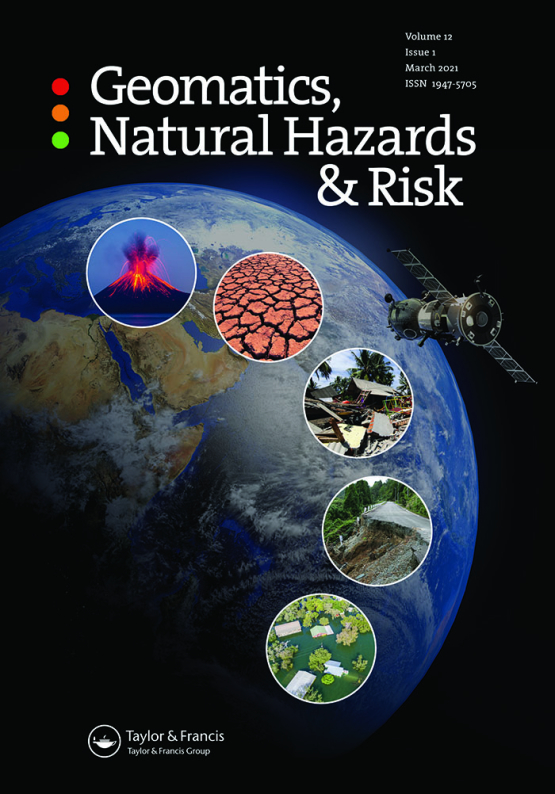
Geomatics, Natural Hazards and Risk
For an Article Collection on
Climate and Natural Hazard Risk: From Hazard Modelling and Impact Assessment to Financial Risk Transfer and Resilience
Manuscript deadline

Article Collection Guest Advisor(s)
Dr. Thong Nguyen-Huy,
University of Southern Queensland, Australia
Thong.Nguyen-Huy@unisq.edu.au
Dr. Andrew Marshall,
University of Southern Queensland, Australia
andrew.marshall@unisq.edu.au
Dr. Timothy Cowan,
University of Southern Queensland, Australia
timothy.cowan@unisq.edu.au
Benefits of Publishing in an Article Collection
An Article Collection is an opportunity for your research to reach the right audience. Bringing together the work of the global research community, Collections provide readers with a central place to find the latest research on emerging and important topics. They have been found to increase the discoverability and visibility of each article, as well as article-level citations.
Climate and Natural Hazard Risk: From Hazard Modelling and Impact Assessment to Financial Risk Transfer and Resilience
Geomatics, Natural Hazards and Risk is pleased to welcome you to submit your research to the Article Collection "Climate and Natural Hazard Risk: From Hazard Modelling and Impact Assessment to Financial Risk Transfer and Resilience".
Climate change and the increasing exposure of communities, infrastructure, ecosystems, and economic activities to natural hazards and extreme events are creating complex and evolving risk landscapes. Effective risk management requires an integrated understanding of how hazards develop, where and when they occur, how they affect exposed systems, and how resulting losses can be quantified and managed. Beyond physical hazard and damage assessments, there is growing interest in translating hazard impacts into resource and financial consequences and developing mechanisms to manage residual risk.
Physical hazard information alone does not fully describe the consequences of disasters or the resources required for recovery, rebuilding and resilience. Reliable estimation of damage and economic losses is therefore important for risk-informed planning, investment, emergency management, and the design of appropriate financial protection mechanisms.
Integrating hazard modelling with exposure and vulnerability assessment, monetary loss estimation, and financial risk analysis can provide a more comprehensive understanding of disaster risk. Such integrated approaches can support governments, insurers, infrastructure managers, communities, and other stakeholders in developing evidence-based strategies for risk reduction, adaptation, resilience, and financial protection.
This Article Collection welcomes original research, review articles, methodological developments, and case studies addressing the assessment and management of climate and natural hazard risk. Topics may include, but are not limited to:
- Earth observation, remote sensing, GIS, and geospatial approaches for hazard and exposure mapping;
- Numerical, statistical, probabilistic, and data-driven modelling of floods, droughts, cyclones, wildfires, landslides, coastal hazards, and other natural hazards;
- Hazard forecasting, impact simulation, and scenario-based risk assessment;
- Assessment of future risk under climate variability and climate change scenarios;
- Vulnerability, exposure, damage, and post-disaster impact assessment;
- Physical-to-economic damage and financial loss estimation;
- Catastrophe risk and probabilistic loss modelling;
- Insurance, reinsurance, parametric and index-based insurance, and other financial risk-transfer mechanisms;
- Disaster risk financing and adaptation investment
- Climate services, forecast-informed decision support, and operational risk management applications; and
- Integrated approaches to risk reduction, climate adaptation, and resilience.
Meet the Guest Advisors
Dr. Thong Nguyen-Huy is a researcher and academic specialising in climate risk, natural hazards, remote sensing, geospatial analysis, and data-driven environmental modelling. His research focuses on understanding climate and environmental extremes, compound hazards, and their impacts on agricultural, environmental, and socio-economic systems, with an emphasis on translating hazard information into actionable risk assessment and resilience strategies.
Associate Professor Andrew Marshall leads Climate Systems Modelling in Agriculture and Water Resources within the Centre for Applied Climate Sciences at the University of Southern Queensland and works in collaboration with the Bureau of Meteorology. His research focuses on climate variability and change, climate services, seasonal prediction, climate risk assessment, and decision support for agriculture, water resources, and natural resource management.
Associate Professor Timothy Cowan is a weather and climate researcher, specialising in climate modelling, climate extremes, seasonal-to-decadal variability, aerosols, and applications of climate and weather research to agriculture. He has research experience in compound extremes, sub-seasonal to seasonal forecasting, attribution, climate extension, as well as having led the development of innovative climate decision tools for the Australian livestock industry.
Benefits of publishing open access within Taylor & Francis
Sustained readership
Publishing in an Article Collection ensures your research reaches a wide and engaged audience, driving long-term readership and citation impact.
Enhanced visibility
Gain recognition by showcasing your work in a trusted and reputable platform, amplifying your research’s visibility and influence.
Trends and methodologies
Connect with emerging topics and methodologies, positioning your research at the forefront of innovation and shaping the future of your field.
Support
Receive expert guidance at every stage of the publishing process from our experienced journal team, ensuring a seamless experience.
Network
Expand your professional network by collaborating with leading researchers from around the world, fostering interdisciplinary connections.
All manuscripts submitted to this Article Collection will undergo desk assessment and peer-review as part of our standard editorial process. Guest Advisors for this Collection will not be involved in peer-reviewing manuscripts unless they are an existing member of the Editorial Board. Please review the journal Aims and Scope and author submission instructions prior to submitting a manuscript.
Submission Instructions
The deadline for submitting manuscripts is 30 July 2027.
Please contact Hang Ke at hang.ke@taylorandfrancis.com with any questions or requests for discount codes relating to this Article Collection.
Please be sure to select the appropriate Article Collection from the drop-down menu in the submission system.