

Submit a Manuscript to the Journal
Sport, Education and Society
For a Special Issue on
Intergenerational learning to shape the future of health and physical education
Abstract deadline
Manuscript deadline
Special Issue Editor(s)
Dylan Scanlon,
Deakin University
dylan.scanlon@deakin.edu.au
Carla Valerio,
Southern Cross University
carla.valerio@scu.edu.au
Jacqui Peters,
Deakin University
jacqui.peters@deakin.edu.au
Laura Alfrey,
Monash University
laura.alfrey@monash.edu
Jenna Lorusso,
University of Limerick
Jenna.Lorusso@ul.ie
Intergenerational learning to shape the future of health and physical education
Existing research suggests that intergenerational learning can strengthen the education system and profession by facilitating, for example, robust professional discourse (Biesta et al., 2015), sustainable workforce development (Nurani & Lee, 2024), and individual and institutional wellbeing and performance (Garcia-Martine et al., 2025). This special issue aims to explore intergenerational learning and its value as a mechanism for collaborative support in navigating the contemporary challenges posed by rapid societal change, particularly within the health and physical education (HPE) and the health and physical education teacher education (HPETE) community (MacPhail, 2020).
This Special Issue builds on a previous work published in Sport Education and Society (Enright, Alfrey & Rynne, 2016), which explored being and becoming a HPE academic in the neoliberal university. Enright et al. (2015) examined a process of intergenerational learning that involved senior academics responding to anonymous letters from early-career academics about issues in the field and questions on career paths. This intergenerational learning was unidirectional, with early-career academics positioned as learning from senior academics. For this special issue, rather than treating intergenerational learning as one-directional, we focus on its multi-directional possibilities. As such, we aim to translate in practice how our notions of learning and working together can be expanded. Intergenerational learning can encourage: wisdom transfer (across generations, not just from senior to early career); communities of learners; cultural continuity; and a deep understanding of contemporary challenges. Therefore, we recognise multi-directionality when knowledge is shared equally amongst people at distinct phases of their careers, regardless of academic position, years of experience, career stage, institutional role, etc.
This Special Issue invites scholars to contribute to the burgeoning field of intergenerational learning. Through exploration, interrogation and problematisation of intergenerational learning itself, or by using it as a lens through which to explore some of the ‘grand challenges’ (MacPhail & Lawson, 2020) in the field of HPE, a broad range of submissions are encouraged. MacPhail and Lawson (2020) conceptualise grand challenges as important, yet complex problems that invite global, collaborative, and cross-boundary thinking and solutions; the authors see grand challenges as catalysts for collaborative redesign of systems (e.g., HPE and HPETE). We position inter-generational learning within this conceptualisation. Grand challenges in contemporary HPE of late have included policy, social justice, health education, cultural responsiveness, neoliberalism, the subject squeeze, the digital age, research and development, professional learning and development, however, submissions should not be limited to these. The exploration of diverse, contextual grand challenges is welcomed and encouraged, as explored through the lens of intergenerational learning.
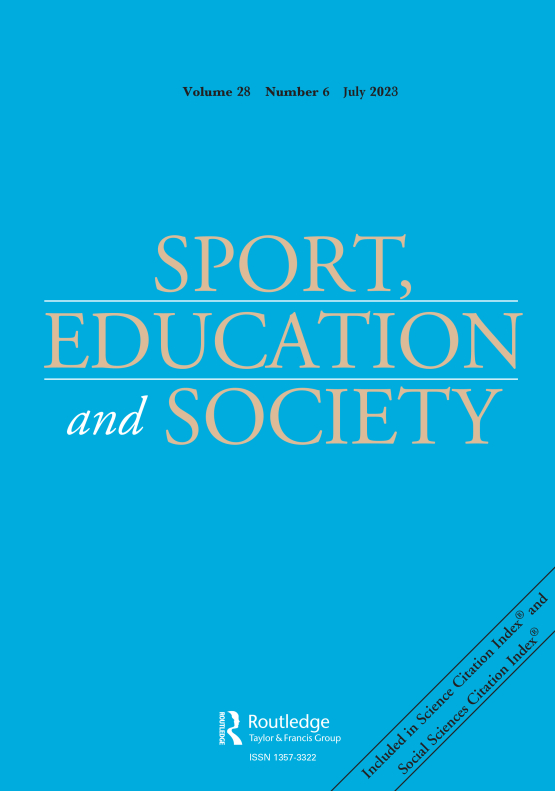
Sport, Education and Society (SES) is an international journal which published research on pedagogy, policy, and the body across physical education, sport, and health contexts. Research in SES is underpinned by critical theories and understandings. This Special Issue is focused on the bringing together diverse voices across generations, fostering innovative methodologies, and acting as a catalyst for new avenues of research in looking at/into grand challenges in HPE and HPETE. We welcome collaborative methodologies to ensure equity in generational input, for example, collaborative self-study, collaborative autoethnographies, collaborative arts-based methodologies, collaborative narrative inquiries, amongst other collaborative innovative methodologies.
This Special Issue will comprise of approximately ten manuscripts.
Submission Instructions
We invite international scholars who are eager to contribute to discussions on the above and open the call to create dialogue across generations and what it means for the future of HPE. The aim of this Special Issue is to create dialogue across generations – in a multi-directional fashion – to gain new insights into the possibilities and challenges of intergenerational learning. Arguably, as outlined, the future of HPE as a discipline and field is facing grand challenges. We – the HPE community – need direction. We need to learn from the past; we need to learn from the future; we need to come together in the present to listen and learn, for transformational action.
The following topics will be considered (but not limited to) for submission:
- Contextual grand challenges in the HPE field through an intergenerational lens (including and beyond the ones mentioned above)
- Intergenerational learning for a more socially-just future
- The future of HPE from an intergenerational lens
- Intergenerational learning for multi-directional capacity-building
- Intergenerational learning for the future of HPETE
- Cultural responsiveness from an intergenerational perspective
While the call for submissions is open to all, our intention is to gather diverse perspectives from multiple contexts to provide a deeper, richer, and more diverse understanding of intergenerational learning and its role in shaping the future of HPE. As such, manuscript authorship teams should consist of individuals from different generations (e.g., ECR, mid-career, and professor), where the focus is on multi-directional learning. We also strongly encourage authorship from minority ethnic backgrounds, Global South, and diverse identities.
To be considered for this Special Issue, we invite you to submit a 300-word abstract to the lead Guest Editor – Dylan Scanlon (dylan.scanlon@deakin.edu.au).
Final paper submissions will be a maximum of 7,500 words inclusive of references.
All submissions should follow SES guidelines and respond directly to the guidelines and themes of this Special Issue, i.e., have authorship teams consisting of different generations (please make this clear on submission) and address one or more of the themes above (additional themes not listed above will also be considered). Please select the Special Issue title when submitting your paper to ScholarOne.
Submission deadlines:
- Abstracts to be submitted by December
- Feedback/confirmations by February
- First drafts due by August
- Final versions by December
Special Issue editors: Dylan Scanlon, Carla Valerio, Jacqui Peters, Laura Alfrey, Jenna Lorusso